


Every other strap guide on this site does the work for you. You give us a reference number, we give you a millimetre.
This one cannot, and it is important to say so plainly: there is no lookup table for vintage Cartier. If you own a Must de Cartier Tank, a vermeil Tank, or any Tank made before the current generation, the only reliable way to get the right strap is to measure the watch yourself. It takes two minutes and it is the difference between a strap that looks factory-fitted and one that never sits right.
Here is why, how to do it, and what to buy once you know.
Why there is no size chart for vintage Cartier
Three things combine to make it genuinely unknowable from a screen.
Cartier never published lug widths, and still doesn't. The maison specifies case dimensions — 23 × 30 mm, 25 × 34 mm — but not the distance between the lugs. Even for current references you have to work it out from the strap.
The vintage Tank was made in a lot of sizes over a lot of years. The Must de Cartier line ran from 1977 into the 1990s, and across that span the case turns up at roughly 20 × 28 mm, 23 × 30 mm, 23 × 31 mm, 23.5 × 31 mm, 25 × 34 mm and larger again in the so-called jumbo versions. Different cases, different lugs, and dealer listings almost never state the width.
Some of them are not whole millimetres. This is the part that catches people out. Vintage Cartier used half-millimetre widths, and it is common enough that at least one specialist strap retailer maintains a dedicated 17.5 mm "(Cartier)" size category purely because of it. Widths of 15.5 mm are reported on smaller vintage Tanks too.
So a strap sold as "fits Cartier Tank" is a guess unless you have measured yours. Two independent strap specialists say the same thing in their own sizing guidance: for any vintage or unlisted Cartier reference, measure directly.
What a Must de Cartier Tank actually is
Worth knowing, because it explains both the watch's charm and one practical warning below.
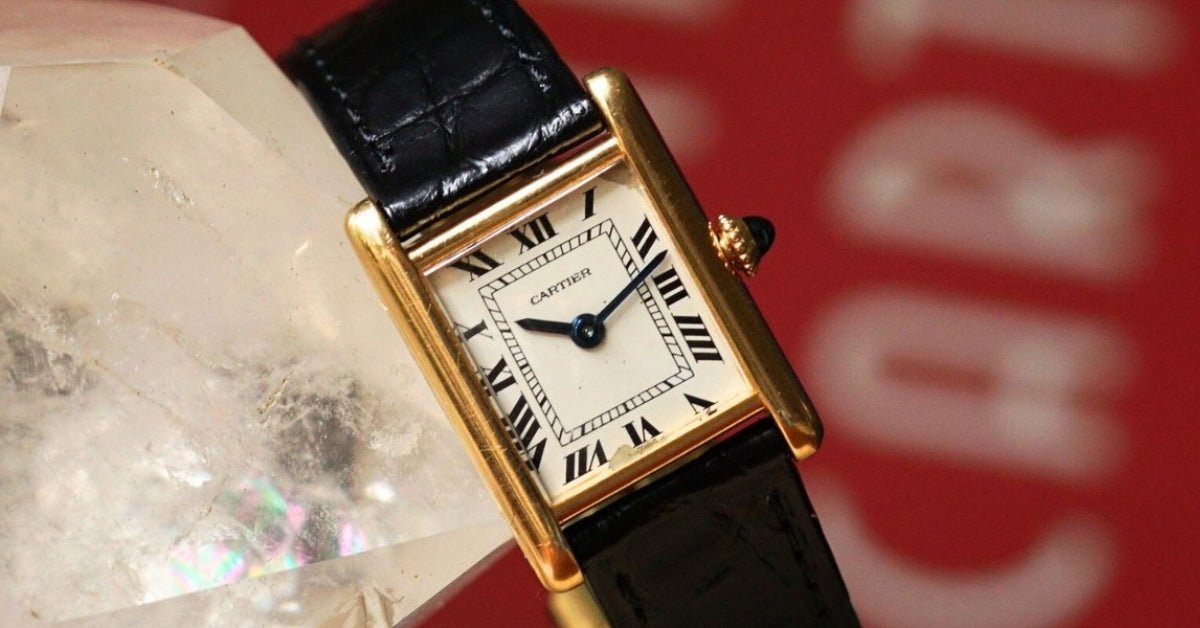
Cartier launched the Must de Cartier line in 1977 as an accessible route into the marque during a difficult decade for the luxury trade. It took the Tank Louis Cartier shape and rendered it in vermeil — solid sterling silver with a heavy gold plating over it, typically around 20 microns. Inside, most manual-wind examples run a Cartier-grade calibre based on the ETA 2512-1; quartz versions are common too.
What made them collectable was the dials. Cartier used the Must line to experiment: burgundy, black, lemon, blue and cream lacquer, some with Roman numerals and a railway minute track, some almost bare. The blued-steel sword hands and the sapphire cabochon in the crown carried over from the gold Tanks.
The practical consequence of vermeil: the case is gold over silver, not solid gold. Where the plating wears through, silver shows. The lug area is exactly where a spring bar tool slips — so if you are changing the strap yourself, go slowly and use a proper tool rather than a penknife. On a solid steel watch a slip is a scratch. On vermeil it can take the plating off.
How to measure your Tank's lug width
You need a ruler with millimetre markings, or ideally a digital caliper.
- Take the old strap off, or push it aside so you can see the gap between the lugs.
- Measure the inside gap — from the inner face of one lug to the inner face of the other. Not the case width. Not the strap you already have, which may be the wrong size already.
- Read it at the lug tips, where the strap actually sits.
- Write it down to the half millimetre. If it reads 17 and a bit, measure again — 17.5 mm is a real Cartier size.
Two sanity checks: the number will almost always fall between 14 mm and 20 mm on a vintage Tank, and it will be an even, symmetrical gap. If you are getting wildly different numbers on each side, you are measuring the case rather than the lugs.
If you would rather not, any watchmaker will measure it in seconds, usually for free.
Buying once you have the number
Our Cartier Tank straps are cut in every whole millimetre from 14 mm to 25 mm — fourteen, fifteen, sixteen, seventeen, eighteen, nineteen, twenty, and up. That granularity exists precisely because Tanks do not come in convenient sizes, and it means most vintage measurements land on a size we actually make.
Being straight about the exception: we do not currently make half sizes. If your watch measures 15.5 mm or 17.5 mm, we cannot fit it properly, and we would rather tell you here than sell you a 16 mm strap that bulges or a 15 mm one that rattles. That is a genuine gap and it is on our list.
One more piece of good news for vintage owners specifically. Our crocodile Tank straps are made in 14, 15, 16 and 17 mm — which is exactly the range most vintage Tanks fall into. On the larger modern Tanks, croc is not an option at all. The small old ones get the best material in the range.
What suits a vermeil Tank
A gold-toned case with a lacquered dial and blued hands wants warmth or contrast, not neutrality. Four that work, in any width you need.
Black Crocodile – the period-correct answer
This is what these watches wore when they were new, and it is still the best-looking thing you can put on one. Croc's relief gives a small watch presence without size, black frames a lacquered dial the way the original Cartier straps did, and — as above — it is available in exactly the widths vintage Tanks use.
→ Black crocodile strap for Cartier Tank
Brown Leather – warm on gold
The most forgiving choice on a vermeil case. Gold plating is warm to begin with, and brown extends that warmth rather than fighting it, which flatters a case that may already show a little honest wear. Daytime, and the strap most vintage Tanks look best on in daylight.
→ Brown leather strap for Cartier Tank
Green Leather – the period colour nobody uses
Cartier spent the Must years experimenting with colour, and green against gold is one of the great combinations of that era — deep, slightly aristocratic, and rare enough on a wrist that people ask about it. If your dial is black, burgundy or cream, this is the strap that makes the watch look chosen rather than inherited.
→ Green leather strap for Cartier Tank
Blue Leather – for the hands and the cabochon
Almost every vintage Tank has two blue elements already: the blued-steel sword hands and the sapphire cabochon in the crown. A blue strap picks both up and turns them from details into a scheme. It also cools a warm gold case for anyone who finds vermeil a little rich.
→ Blue leather strap for Cartier Tank
Black, red, pink and white are cut to the same widths — see everything in the Cartier Tank strap collection.
One detail that matters more on a vermeil case
Choose the gold buckle. Our Tank straps come with a choice of silver, gold or rose gold hardware, and on a vermeil case a steel-coloured buckle is the single most common way to make a genuinely lovely old watch look like it is wearing a borrowed strap. If your watch came with its original Cartier folding clasp, keep that instead — our straps work with it.
Quick Recap
- Measure the inside gap between the lugs. Do not guess from the case size or the old strap
- Vintage Tanks are usually 14–20 mm, and some are half sizes
- We make every whole millimetre from 14 mm to 25 mm; we do not make 15.5 or 17.5
- Crocodile is available in 14–17 mm — the vintage sizes
- Gold buckle on a vermeil case, or keep the original Cartier clasp
- Change the strap carefully: vermeil is plating, and the lugs are where it wears
For current-production references we do have exact numbers — see the Cartier strap guide index, including the Tank Must WSTA0041 guide.
Made in Every Millimetre, Because Tanks Are
Most strap makers stock the three or four Tank sizes that cover the current catalogue. We cut every whole millimetre from 14 to 25 because the Tank has been made for a hundred years and the old ones do not care what is convenient.
More than 50,000 customers worldwide, free shipping and free returns, and no import costs on any order, from any country. Leather and crocodile straps are covered by a one-year warranty.