


If you only ever buy one aftermarket strap for a luxury watch, make it FKM rubber. It's the single highest-impact upgrade you can make to a Rolex, Cartier, Omega, Tudor, AP, or Patek — bigger than any bezel insert, any service polish, any aftermarket bracelet. It transforms how the watch wears. It protects the OEM bracelet you paid thousands for. It opens the watch up to every situation a leather strap can't go to. And it does all of this for £100–£300, which is somewhere between 1% and 10% of what the watch itself cost.
This isn't a "rubber is good" article. We've already covered the technical case for FKM over silicone, and we've covered every strap material in the materials guide. This is the case for why aftermarket rubber, specifically, is the upgrade most luxury watch owners should make first — and why the most common reasons people resist it (the watch will look cheap, it'll devalue the piece, real watch enthusiasts only wear bracelets) are mostly wrong.
The Watch You Bought Is Designed for One Look. The Watch You Wear Has Two.
Here's the central observation. Most luxury sport watches are bought on a steel bracelet — the Submariner, the Datejust, the Speedmaster, the Royal Oak, the Black Bay. The bracelet is part of the original design language. It's beautiful, it's well-engineered, and on the day you buy the watch it feels like the only correct way to wear it.
Then summer arrives. Or you go on holiday somewhere humid. Or you start working out in the watch. Or you go to the beach. Suddenly the bracelet stops being beautiful and starts being heavy, hot, link-pinching, and in the way. Steel doesn't breathe. Steel traps sweat between the case and the wrist. Steel scratches against desk edges and laptop palm rests. By July, half of the people who bought their watch in February are quietly leaving it in the safe and wearing something else.
That's exactly the problem rubber solves. A quality aftermarket FKM strap turns one watch into two — the formal/professional bracelet version and the everyday/sport rubber version. Same watch, completely different wearing experience. The watch comes out of the safe and starts living a real life again.
This isn't an argument against bracelets. The OEM bracelet is the right choice for offices, dinners, formal occasions, and the days you want the watch to look its most "this is the watch as Rolex / Patek / AP designed it." The argument is that a single watch on a single strap is a one-mode object, and rubber is what gives it the second mode without requiring you to buy a second watch.
Watchmakers Themselves Already Made This Decision
The fastest way to understand why rubber on a luxury watch isn't a downgrade is to look at what the watchmakers have done themselves over the last two decades.
Rolex introduced the Oysterflex bracelet on the Yacht-Master in 2015 and rolled it out across the gold Daytona, gold GMT-Master II, and Sky-Dweller platinum. Oysterflex is, by Rolex's own description, a metal-cored elastomeric blade — i.e., FKM rubber wrapped around a flexible titanium spine. Rolex did this because at the £30,000+ price point, demanding rubber on a precious-metal sport watch was something serious customers wanted, not because they cut corners.
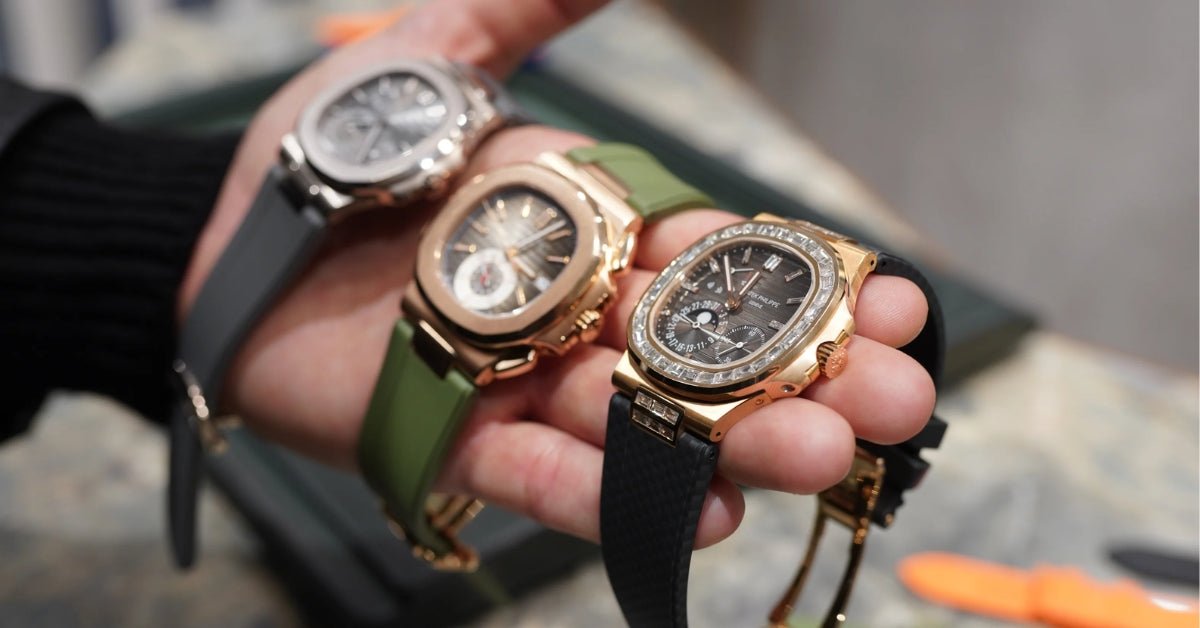
Patek Philippe launched the Aquanaut in 1997 specifically as a rubber-strap luxury sport watch, and the Aquanaut is now Patek's second best-selling line behind the Nautilus. Patek doesn't put rubber on watches as a budget option — they put it on watches that retail above £40,000 because the strap is fundamental to the design.
Audemars Piguet's Royal Oak Offshore Diver has shipped on factory rubber for years across the platinum, ceramic, and stainless variants. Hublot built its entire identity around rubber on precious-metal cases starting in the 1980s. Blancpain offers the Fifty Fathoms on rubber in titanium and steel. Vacheron Constantin put rubber on the Overseas. Panerai effectively pioneered modern thick-rubber dive straps as the default option on every Submersible.
The decision-makers at these brands have access to every material on earth. They put rubber on watches that retail for £30,000–£300,000 not because rubber is cheap, but because rubber genuinely works on luxury watches. The aftermarket category exists because once you accept that premise — and the premise is now well established — you don't have to spend another £30,000 to get the rubber experience on a watch you already own.
The Case for Aftermarket Specifically (Not OEM)
OEM rubber straps, when available, are excellent. They're also expensive (Rolex Oysterflex retail is roughly £400–£700 depending on reference and Rolex makes it difficult to source separately), restrictive (Rolex Oysterflex is sold mostly with new watches; you can't generally just walk in and buy one for your existing watch), and limited in colour choice. A luxury aftermarket strap solves all three problems.
The price gap is meaningful. A premium aftermarket curved-end FKM rubber strap from a serious maker costs roughly £100–£300, depending on construction, complexity, and brand. You're getting the same FKM material, often the same Swiss tannery and rubber compound, with the same case-fit precision — for a fraction of OEM pricing. The savings let you buy two or three different colours rather than committing to one OEM black.
Choice matters more than people expect. OEM rubber for most luxury watches comes in black, with one or two seasonal colour exceptions. The aftermarket gives you matte black, glossy black, charcoal, navy, racing green, deep red, white, beige, orange, rose, and dozens of other colours per case profile. A black-dial Submariner with a navy rubber strap looks different — meaningfully different — from a black-dial Submariner with a black rubber strap. Twenty colour options is the difference between "I have one rubber strap" and "I rotate three depending on the season and outfit."
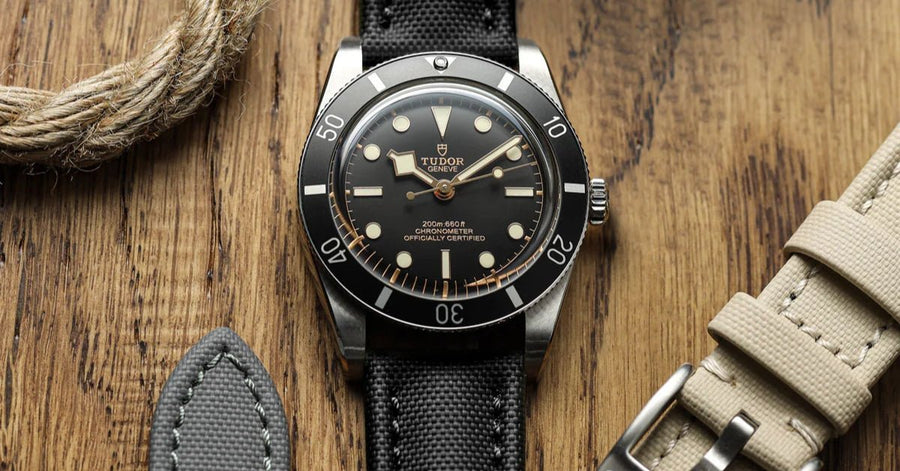
Availability matters most. Many luxury watchmakers don't sell aftermarket-fit rubber for their own watches at all. There's no Cartier Santos rubber strap from Cartier. There's no Speedmaster rubber strap from Omega for older references. There's no Tudor Black Bay 58 rubber from Tudor in most markets. The aftermarket is the only path to rubber on these watches, and it's a path that good aftermarket makers have been walking for over a decade.
The Five Specific Things Aftermarket Rubber Does
Strip away the marketing, and aftermarket FKM rubber upgrades a luxury watch in five specific, concrete ways.
1. It cuts weight by 60–80% versus a steel bracelet. A Rolex Submariner Oyster bracelet weighs around 95 grams. The watch head alone weighs around 60 grams. A premium FKM rubber strap weighs around 12–18 grams. Switching from bracelet to rubber takes the total wrist weight from ~155g to ~75g. After eight hours, the difference is genuinely noticeable — the watch stops being something you're wearing and starts being something you've forgotten about. Sport watches were designed for daily wear; weight-cutting makes them daily-wearable.
2. It opens the watch to water without consequence. Leather straps and water are incompatible — covered in detail in the leather-care article. Steel bracelets handle water but trap chlorine, salt, and humidity in the link gaps where you can't easily clean it. FKM rubber is fully waterproof, fully chlorine-resistant, fully salt-resistant, and rinses clean in 10 seconds under a tap. The watch can come into the pool, the shower, the sea, the gym sauna, the rain. Whatever the case water resistance allows, the strap will allow.
3. It preserves the OEM bracelet from daily wear. This is the single most under-discussed argument for aftermarket rubber. A Rolex Oyster bracelet on daily wear accumulates micro-scratches, hairlines on the centre links, stretch in the bracelet pivot pins, and gradual end-link wear where the bracelet meets the case. None of this is structurally damaging, but cumulatively over a decade of daily wear it ages the bracelet to the point where a service polish becomes the only path back to "looks new." A bracelet that lives on the watch only on the days you really need it — formal occasions, photographs, sales — keeps the watch fresher for the long term and protects the resale value of the bracelet specifically.
4. It eliminates the "luxury watch I'm scared to wear" problem. Many people own a Rolex, AP, or Patek and wear it 20–30% as much as they expected to, because every day they pick it up they have to weigh "do I want to risk this on a steel bracelet today?" Rubber removes the weighing. You're not exposing the OEM bracelet to weather, sweat, gym, beach, or a spilled drink. You're exposing a £150 strap that's literally designed for those situations. The watch comes out of the safe more often, and the watch you wear is a better watch than the watch sitting in a safe.
5. It costs roughly £15 per year of wear. A premium FKM rubber strap costs around £150 and lasts 5–10 years of regular wear (the rubber is fundamentally non-biodegradable in the timeframe a strap is used). On a £150 strap worn for 8 years, that's £18.75 per year of dramatic transformation in how the watch wears. Compared to a £150 leather strap that lasts 18–24 months under daily wear, the cost-per-year math heavily favours rubber.
The Three Objections (And Why They Mostly Don't Hold)
There are three common reasons people resist putting rubber on their luxury watch. They're worth addressing honestly because each one has a kernel of truth.
"It'll cheapen the watch." This was the dominant argument in the 1990s when most rubber straps were genuinely cheap-looking — black silicone, soft, no fitment to the case. It's mostly wrong today, and the watchmakers themselves dismantled the argument by putting rubber on £30,000+ watches as standard. The actual question is whether the specific strap you're choosing matches the register of the watch. A poorly-fitted, low-quality rubber strap on a Patek looks bad. A precisely-cut, premium FKM strap from a serious maker on the same Patek looks different from the bracelet but doesn't look cheap. Quality matters; rubber as a category isn't the problem.
"Real watch enthusiasts wear bracelets / leather, not rubber." This is partly cultural and partly outdated. The modern serious-collector consensus has shifted considerably in the last decade, and most active collectors now own at least one rubber strap for at least one of their sport watches. The contrarians who insist on bracelets-or-leather are almost always older collectors who came up before the modern luxury rubber category existed. Among collectors under 50, rubber is a default option in the rotation, not an unconventional one.
"The watch was designed to be worn on the bracelet." Strictly true for some watches. The Datejust, the Day-Date, the Patek Calatrava — these are leather and bracelet watches by design and rubber is wrong on them. But sport watches — Submariner, GMT, Daytona, Speedmaster, Black Bay, Aquanaut, Royal Oak Offshore, Santos, Pelagos — were almost all designed with the assumption that the wearer would put them through real activity. Rubber is closer to the original design intent of those watches than office-only bracelet wear is.
Watch-by-Watch: Where Rubber Genuinely Wins
Rubber is the best upgrade for some watches. It's not the best upgrade for others. The honest breakdown:
Strong rubber upgrades (rubber is genuinely transformative): Rolex Submariner, GMT-Master II, Daytona, Sea-Dweller, Yacht-Master, Sky-Dweller. Tudor Black Bay (all sizes), Pelagos. Omega Seamaster Diver, Seamaster Aqua Terra, Speedmaster (especially in summer). AP Royal Oak Offshore (especially Diver). Patek Aquanaut. Hublot Big Bang, Classic Fusion. Cartier Santos (modern). Panerai Luminor, Submersible. IWC Aquatimer. Tag Heuer Aquaracer.
Moderate rubber upgrades (rubber works but isn't the only good answer): Rolex Datejust, Day-Date, Air-King, Explorer (depends on use case). Cartier Pasha, Calibre. IWC Pilot, Big Pilot. Breitling Navitimer, Avenger. Tag Heuer Carrera.
Poor rubber candidates (stay with bracelet or leather): Cartier Tank (all variants), Tank Louis, Tank Américaine. Patek Calatrava. Vacheron Patrimony. Lange Saxonia, Lange 1. JLC Master Ultra Thin, Reverso. Cartier Ronde Solo, Ballon Bleu (debatable). These are dress watches where rubber is fundamentally the wrong register.
If your watch is in the first category, an aftermarket FKM rubber strap is probably the highest-impact thing you can add. If it's in the second category, rubber is one of several good options. If it's in the third, rubber is the wrong move and you should be looking at leather, alligator, or the OEM strap.
What to Look For in a Quality Aftermarket Rubber Strap
The category has a wide quality range. Five things separate good aftermarket rubber from cheap aftermarket rubber:
Genuine FKM, not silicone. This is the single biggest differentiator. Cheap "rubber" straps for luxury watches are almost always silicone — soft, dust-attracting, lifespan measured in months rather than years. Genuine FKM (fluoroelastomer) is the same material Rolex uses in Oysterflex, lasts 5–10+ years, and looks visibly more refined. If a strap costs £15–30 for a luxury watch, it's silicone. Real FKM starts around £80 and runs to £300+ depending on construction.
Curved-end fit cut for your specific watch. Covered in detail in the curved-vs-straight article. A curved-end strap engineered for the Submariner case profile sits flush against the case and looks like an integrated design element. A generic straight-end strap leaves a visible gap and looks like an aftermarket afterthought. For most luxury sport watches, curved-end is the better look.
Welded-knob quick-release spring bars. Standard on premium aftermarket; absent on cheap. The welded-knob construction means the spring bar lever can't fall off over time, and quick-release lets you swap straps in 30 seconds without scratching the lugs.
Proper buckle / clasp matching. A good aftermarket strap either uses the OEM clasp (Rolex Glidelock, AP folding clasp, etc.) or supplies a buckle that matches the watch's case finish — brushed steel for brushed cases, polished for polished, gold-tone for gold cases. Mismatched hardware is the giveaway of cheap straps.
A real warranty. Premium aftermarket rubber typically comes with 12-month or lifetime warranties. Helvetus rubber straps are backed by a lifetime warranty against material defects. If a strap brand offers no warranty or a 30-day return only, the manufacturer doesn't believe in the product's longevity, which tells you what you need to know.
Frequently Asked Questions
Will switching to rubber affect my watch's resale value? No, as long as you keep the OEM bracelet. Resale buyers want the watch with all the original parts. Selling a Submariner with the Oyster bracelet boxed alongside an aftermarket rubber strap doesn't reduce value — if anything, the rubber is a small bonus. Selling a Submariner without the OEM bracelet would reduce value, but no one's suggesting you discard it.
Can I switch back to the OEM bracelet whenever I want? Yes. With quick-release spring bars, swapping between OEM bracelet and aftermarket rubber takes about 60 seconds total. Most owners with both go back and forth depending on the day, the weather, or the occasion.
Does rubber wear out faster than leather? The opposite. A quality FKM rubber strap on daily wear lasts 5–10 years. A quality leather strap on daily wear lasts 12–24 months. Per year of wear, rubber is dramatically cheaper than leather.
Will rubber make my watch slip more than the bracelet? No, with the right length. A correctly-sized rubber strap holds the watch as securely as a bracelet, sometimes more so because rubber has more grip against skin than steel does. A too-loose rubber strap will slide; that's a sizing issue, not a material issue.
What's the difference between OEM rubber (like Oysterflex) and aftermarket rubber? The fundamental material — FKM rubber — is often the same. The case-fit precision can be the same when the aftermarket maker has cut the strap specifically for your reference. The biggest difference is usually price (aftermarket is 30–80% cheaper) and choice (aftermarket offers far more colours and configurations). For most owners, aftermarket FKM is functionally indistinguishable from OEM at one-third the cost.
Can I swim, shower, and exercise in an aftermarket rubber strap? Yes. Premium FKM is rated for full water exposure, including pools (chlorine), oceans (saltwater), gyms (sweat), and showers (soap, shampoo). Rinse with fresh water afterward to keep the strap looking new. The watch's own water resistance is the only limit — the strap won't be.
Is FKM rubber hypoallergenic? Yes. FKM is fundamentally inert and hypoallergenic. People with metal sensitivities to nickel-containing alloys often actively prefer rubber over steel bracelets for this reason.
My watch came on a bracelet. Will an aftermarket rubber strap fit? For 95% of mainstream luxury references — yes. The strap maker's product page should specify which references the curved-end fitment is engineered for. For watches with proprietary integrated bracelets (Patek Nautilus, AP Royal Oak, Vacheron Overseas), specialist aftermarket options exist but are more limited.
The Bottom Line
A quality aftermarket FKM rubber strap is the single best upgrade you can make to a luxury sport watch — bigger than any service, any modification, any accessory. It cuts weight by 60–80%. It opens the watch to water and weather without consequence. It preserves the OEM bracelet from daily wear. It eliminates the "watch I'm scared to wear" problem. It costs roughly £15–25 per year of useful life. And it does all of this without affecting the resale value of the watch, because the OEM bracelet stays preserved alongside it.
The watchmakers themselves already made this case. Rolex put FKM on the Oysterflex. Patek built the Aquanaut around it. AP, Hublot, Blancpain, Vacheron, Panerai — every serious luxury sport watchmaker has rubber as a factory-standard option somewhere in their range, on watches that retail well into the five and six figures. The aftermarket category exists because once that premise is established, you don't need to spend £30,000+ to get the rubber experience on a watch you already own.
If you have a Rolex, Cartier Santos, Omega, Tudor, AP, Patek, Hublot, Panerai, IWC, Tag Heuer, or Breitling sport watch, an aftermarket FKM rubber strap is almost certainly the highest-leverage upgrade available to you. The upside is enormous — daily wearability, weather and water access, OEM bracelet preservation, total transformation of how the watch lives. The downside is £100–£300 you can recover anytime by switching back to the bracelet.
Helvetus makes premium aftermarket FKM rubber straps in curved-end fit cut for specific Rolex, Cartier, Omega, Tudor, Patek, AP, IWC, Panerai, Tag Heuer, and Breitling references, with straight-end universal-fit options in 20mm, 22mm, and 24mm for any standard lug width, and CTS cut-to-size rubber for buyers who want to trim to their exact wrist length the same way Patek does on the Aquanaut. All rubber straps backed by a lifetime warranty.
Most of our customers wear Rolex or Cartier — both well-served. The Rolex strap collection covers every major Rolex sport reference (Submariner, GMT-Master II, Daytona, Sea-Dweller, Yacht-Master, Sky-Dweller, Datejust, Day-Date, Explorer, Air-King) with curved-end FKM cut specifically for each case profile. The Cartier strap collection covers the Santos and other Cartier references where rubber is a strong fit (Tank stays in alligator and calf — different register). Browse the full range at helvetus.com, use our Strap Finder to match the right rubber to your specific watch reference, or read more on the Helvetus blog.