


The spring bar is the smallest, cheapest, and most important component of any watch strap. It's the entire reason your watch stays attached to your wrist instead of sitting on the floor, and yet most people couldn't describe how one works if you asked them. That's been the case for over a century — the first verifiable patents for the wristwatch spring bar date back to around 1915, and the basic design has barely changed since.
What has changed, in roughly the last fifteen years, is how you take it in and out. The standard spring bar requires a small forked tool, careful technique, and accepts the small risk of scratching your lugs every time you swap a strap. The quick release spring bar — QRSB for short — has a tiny lever built into the bar that lets you remove and refit the strap with your fingers in about thirty seconds, no tool required, no scratch risk, no swearing.
This guide covers what quick release spring bars are, how they work, why every premium strap should have them as standard, the legitimate concerns about them, and the small list of watches where you genuinely can't use them.
What a Standard Spring Bar Actually Is
Before the quick release version makes sense, you need to understand what a normal spring bar is and why the original design has limitations.
A spring bar is essentially a small metal tube containing a coil spring with two pins protruding from the ends. The pins are pushed outward by spring tension. To fit a strap, you compress the bar slightly so the pins retract into the tube, slot the bar into the holes drilled into the inside of the watch's lugs, and let the spring expand so the pins lock into those holes. The spring tension is what holds your strap onto the watch.
It's clever, it's been refined steadily since the 1915-era patents through to the 1941 U.S. patent (US2308505A) that documents the mature double-flange design, and most modern watches — from a £30 Casio to a Patek Philippe — use essentially the same component. Standard sizes: 16mm to 24mm wide in 1mm increments, 1.5mm or 1.8mm in body diameter, made of stainless steel.
The problem isn't the spring bar itself. The problem is removing it.
Why Removing a Standard Spring Bar Is Mildly Annoying
To swap a strap with standard spring bars, you need a spring bar tool — a small handle with a forked end on one side and a pin end on the other. The forked end slips between the strap and the watch case, hooks under the bar's flange, and lets you push the bar inward to compress the spring. While holding the bar compressed, you slide one end out of the lug hole, then the other. Reverse the process to install the new strap.
If your strap still uses standard spring bars, our bracelet removal tool (forked and pin ends, 12–26mm lugs) or the spring bar tweezer, which compresses both ends at once, makes the swap quicker and lowers the risk of scratches.
Done well, the whole thing takes 3–5 minutes per strap change. Done badly, it takes longer and produces a small list of common consequences:
The fork slips off the spring bar mid-compression and the bar shoots across the room. Spring bars are tiny, lightweight, and fast — most people who swap straps regularly have lost at least one this way.
The fork slips and scratches the lugs of the watch. This is the bigger problem on a Rolex, Cartier, or any luxury watch where the lugs are polished. A single scratch from a slipped tool is permanent and visible.
The watch falls. With both spring bars compressed at once, or with one removed and one being worked on, there's a window where the watch isn't securely held by anything except your fingers. A slip means the watch hits the desk or the floor.
You give up and don't change the strap as often as you'd like.
The last point is the real cost. A watch with a single strap gets worn the same way every day. A watch with three or four straps in rotation looks different depending on the occasion and the straps last longer because each one wears slower. The friction of swapping straps with a tool is just enough to discourage people from doing it as often as they otherwise would.
What a Quick Release Spring Bar Does Differently
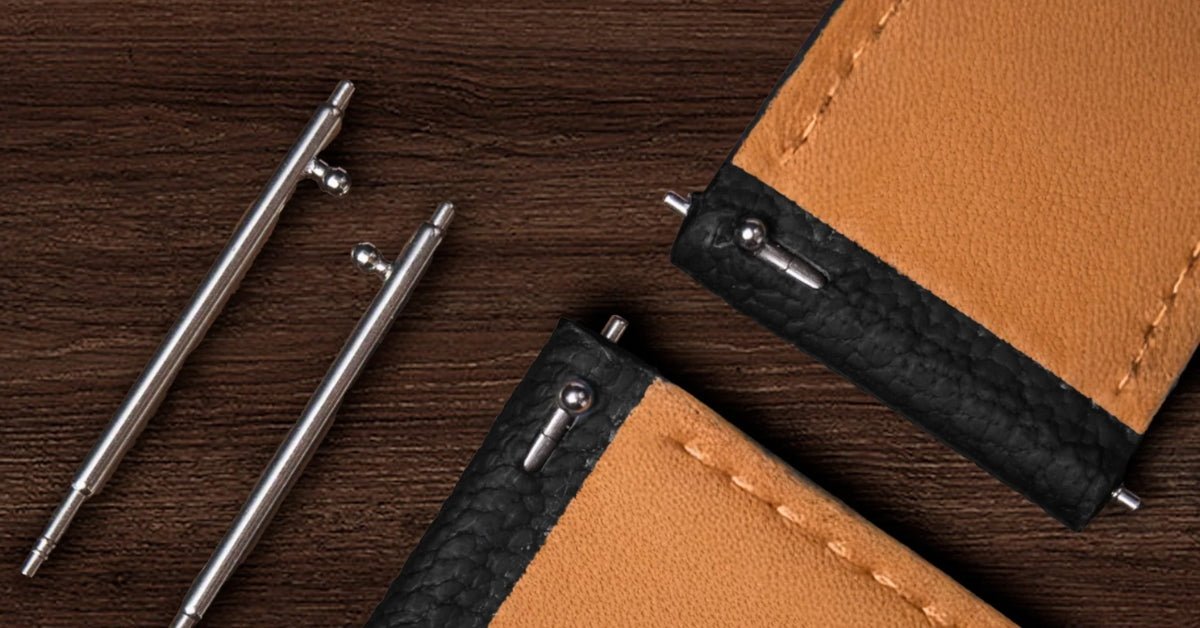
A quick release spring bar is a normal spring bar with one extra component: a small lever or knob built into the side of the bar, near one end. The lever connects to one of the pins. Pushing the lever in retracts the pin into the bar without you needing to slip a tool between the strap and the case.
That's the entire mechanism. The bar still works as a spring bar — the spring tension still holds the strap to the watch through the pins — but you can release one pin without any tool, and that's enough to slide the strap off the lug.
In practice, the swap process is:
- Push the lever with a fingernail or a small flat object.
- The pin retracts.
- Tilt that end of the strap away from the watch, releasing the bar from the lug hole.
- The other pin slides out of its lug hole easily because it's no longer under pressure.
- The strap is off.
To install a new strap with QRSB already fitted, the process reverses: insert the non-lever end into one lug, push the lever, slot the lever end into the other lug, release the lever, done. The total time per swap is about 20–30 seconds, no tool, no scratch risk.
The lever sits on the underside of the strap, between the strap and the watch case, where it's invisible during normal wear. Most people never see it once the strap is on.
The Five Real Benefits
There are five concrete reasons quick release should be the default on any premium strap.
1. No tool required. The most obvious benefit. If you don't own a spring bar tool, you don't need to buy one. If you do own one, you don't need to find it.
2. No scratch risk. This is the bigger benefit for luxury watch owners. A spring bar tool slipping and scratching the lugs is the single most common form of self-inflicted damage on a Rolex, Cartier, Omega, or any other watch with polished or brushed lugs. Quick release eliminates the risk entirely because you never put a hard metal tool near the case.
3. The watch stays held the whole time. With a QRSB swap, only one pin is released at a time, and the bar stays inside the strap. The watch is securely attached to one end of the strap throughout the swap. There's no point at which a slip results in the watch falling.
4. Strap rotation actually happens. This sounds minor and isn't. A 30-second swap means people actually swap straps — for a meeting, for the weekend, for the gym. Daily-rotated straps last 2–3x as long as straps worn every day, because each one gets fewer hours of wear. The mechanism that makes swapping easier extends the useful life of every strap in your rotation.
5. The barrier to trying new straps drops. Most collectors who own quick release straps end up owning more strap variations than they otherwise would. The friction was the limiting factor.
The Legitimate Concerns (Honestly Addressed)
A small minority of watch enthusiasts — usually long-time owners who learned strap changes with traditional tools — argue against quick release on principle. The arguments are worth taking seriously, even when they don't fully hold up.
"Quick release bars are less secure than standard bars." This is the most common objection and it's mostly wrong. Both types use the same spring mechanism with the same tension. A quality quick release bar has the same holding force as a quality standard bar. The cases where QRSB fail are almost always cheap manufacturing — knobs that aren't welded properly, poorly tempered springs, low-grade steel — and the same quality issues affect cheap standard spring bars equally. Buy quality, and the security difference is statistically zero.
"The lever can fall off." True for cheaply made QRSBs, where the knob is wedged onto the spring bar rather than welded. Higher-quality versions (like the welded-knob designs that became standard around 2022) eliminate this. If a knob does come off, the bar still functions as a normal spring bar — you can still remove it with a regular spring bar tool, you just lose the quick release function.
"The lever is visible." True, but only on the underside of the strap, between the strap and the case, at the lug. From any normal viewing angle the lever is invisible. The argument is mostly aesthetic and mostly hypothetical.
"Real watch enthusiasts use proper spring bars and tools." This is more cultural than technical. There's no functional advantage to standard spring bars on a watch that supports quick release. The argument is essentially "I'm used to it" — which is fine as a personal preference, but isn't an argument against quick release as a category.
The honest answer: for the vast majority of watches and the vast majority of people, quick release is straightforwardly better. Quality matters more than mechanism, and a quality QRSB outperforms a cheap standard bar by every metric.
When You Can't Use Quick Release
There are real cases where QRSB doesn't work, and it's worth knowing them.
Watches with proprietary bracelet systems. Patek Nautilus, AP Royal Oak, Vacheron Overseas, Hublot Big Bang and similar integrated-bracelet watches have specific case-to-strap connection systems engineered for that watch. Standard quick release won't fit, and the brand's own integration systems are required.
Watches that need specialty spring bars. Some Seiko references use "fat" spring bars with thicker tips than standard. Some vintage and military watches use fixed bars (welded into the lugs, no removal possible). Some Cartier references use dedicated screw-bar systems. None of these support generic QRSB.
Watches with drilled lugs. These watches have small holes drilled through the outside of the lugs, allowing you to push the spring bar in from the outside with a pin tool. On these watches, QRSB technically works but the original push-pin method is just as fast and arguably more reliable.
Watches with proprietary "quick change" systems. Cartier's QuickSwitch, Omega's NTRC strap-change buttons, Apple Watch's slide-and-click system, and Tudor's T-fit/quick-change all use case-side mechanisms instead of spring bars. These are often even faster than QRSB but they only accept straps engineered specifically for the system.
For everything else — Rolex, Tudor (older references), Omega (most), Cartier Tank, IWC, Panerai, Breitling, Tag Heuer, the bulk of the market — quick release works perfectly.
How to Tell If Your Strap Has Quick Release
Easiest test: turn the strap over and look at the spring bar at each end. If you see a small lever or knob protruding from one side of the bar, it's quick release. If the bar is smooth with no visible mechanism, it's standard.
Most premium strap makers now ship quick release as default. Helvetus fits quick release spring bars to all standard rubber, leather, sailcloth, and exotic leather straps unless the watch reference requires a specialty bar. If a strap doesn't list quick release on the product page, it's worth checking — some brands still ship standard spring bars to cut costs.
What Quality Quick Release Looks Like
Not all QRSBs are equal. The quality differences are real and they matter.
Welded vs wedged knobs. Cheap QRSBs have the lever knob press-fit onto the spring bar — wedged into place rather than welded. Over time and through repeated use, the knob can come loose and fall off. Quality QRSBs have welded knobs that can't be pried off even intentionally. The difference is invisible from the outside, but you can usually tell from the price.
Spring tension and steel grade. A quality QRSB uses 316L (or sometimes 904L) stainless steel with a properly tempered spring. Cheap versions use lower-grade steel and weaker springs that can fatigue over years of use. Premium straps use premium spring bars; £15 Amazon straps usually don't.
Diameter consistency. Standard QRSBs are 1.5mm or 1.8mm in body diameter. The fit between the spring bar tips and the lug holes needs to be precise — too thin and the strap has play; too thick and it won't fit. Quality manufacturers hold tight tolerances on this; cheap ones don't.
If a strap costs under £30 and includes "quick release," investigate the QRSB quality before relying on it. For straps from established premium brands — Helvetus, Delugs, Everest, Hirsch, Crafter Blue, Rubber B and similar — the QRSB quality is generally high and reliable.
How to Use Quick Release Spring Bars (Step by Step)
The process is so simple that it barely needs instructions, but here it is for completeness.
To remove a strap with QRSB:
- Hold the watch upside down so you can see the underside of the strap where it meets the lug.
- Locate the small lever protruding from the spring bar.
- Push the lever toward the centre of the strap with a fingernail or a small flat object (a coin works).
- While holding the lever, tilt that end of the strap away from the lug. The bar will release.
- The other end of the strap will slide out easily.
To install a strap with QRSB:
- Slot the non-lever end of the spring bar into one of the watch lugs first.
- Push the lever in to retract that pin.
- Slide the lever end of the bar into the other lug while the lever is depressed.
- Release the lever. The pin should pop out into the lug hole and lock the strap in place.
- Tug gently on the strap to confirm it's secure.
If you have a tool, the process is slightly faster but not meaningfully different. With practice, a strap swap takes about 20 seconds without any tool at all.
Frequently Asked Questions
Are quick release spring bars as secure as standard ones? Yes, when made well. Both use identical spring mechanisms with identical holding force. Quality matters far more than mechanism — a quality QRSB is more secure than a cheap standard bar.
Can I install quick release spring bars on a strap that came with standard bars? Sometimes. The strap needs notches cut into the underside near each lug to allow finger access to the lever. Some straps have these by default; some don't. If your strap doesn't have notches, the QRSB will fit but you won't be able to access the lever — which defeats the point.
Do quick release spring bars work with all watches? With most. Watches with proprietary bracelet systems (Patek Nautilus, AP Royal Oak), specialty spring bars (Seiko fatties, vintage references), or non-spring-bar attachment (Apple Watch, Cartier QuickSwitch, Omega NTRC) need their own systems. For 90% of watches, QRSB works perfectly.
Will the lever scratch the inside of my watch case? No. The lever sits inside the strap, between the strap material and the case. It doesn't contact the case at any point.
Can the lever come loose? On cheap QRSBs, yes — the wedged knob can detach over years of use. On welded-knob designs (now standard for premium straps), no.
Does quick release affect water resistance? No. The spring bar is below the watch case, not part of the case sealing. Water resistance is determined by the case gaskets, crown, caseback, and crystal — not by the strap attachment.
Is it worth replacing standard spring bars with QRSB on my existing straps? Usually yes, if you change straps more than once or twice a year. A pack of quality QRSBs costs around £15–25, and the convenience pays off within a couple of strap swaps.
Can I use quick release straps on a watch with drilled lugs? Yes, though drilled-lug watches already let you push a pin tool through the outside of the lug, which is similarly fast. QRSB works fine on drilled lugs but the speed advantage is smaller.
The Bottom Line
Quick release spring bars are one of those small upgrades that change the experience of owning watches more than the spec sheet suggests. They take a strap swap from a 5-minute job with risks attached to a 30-second job with no risks. They eliminate scratched lugs. They make rotation actually happen, which extends the life of every strap you own.
For 90% of watches, there's no reason to choose standard spring bars over quick release. The remaining 10% — proprietary bracelets, specialty bars, vintage references — have their own mechanisms anyway. Buy quality QRSBs from brands that weld the knobs and use proper spring steel, and the failure mode that critics worry about doesn't actually happen.
Helvetus fits welded-knob quick release spring bars to every strap in our curved-end FKM rubber, straight-end FKM rubber, leather, sailcloth, and exotic leather collections, except where the watch reference requires a specialty bar. We also stock standalone quick release spring bars and watchmaker-grade strap tools for collectors who prefer the traditional method or have older straps to upgrade.
Most of our customers wear Rolex or Cartier — both work perfectly with quick release. The dedicated Rolex strap collection and Cartier strap collection include curved-end and straight-end pieces, all fitted with quick release as standard. Browse the full range at helvetus.com, use our Strap Finder to match the right strap and end-fit to your watch, or read more on the Helvetus blog.