



The doors at Palexpo closed on Watches & Wonders 2026 today. After seven days — four professional, three public — the watch world has spoken, and Geneva has delivered one of the most ambitious, most technically varied, and most debated editions of the fair in recent memory.
Our team covered the week from the floor, from day one's opening announcements through to the final public day. Across that week, we published daily dispatches on every major brand and release as they happened. This article is the synthesis — the full picture of what Watches & Wonders 2026 actually was, which watches defined it, what the industry is saying about where it is going, and what collectors, enthusiasts, and anyone who wears a watch on their wrist should take away from Geneva in April 2026.
For our dedicated Rolex coverage, you can read the complete Rolex 2026 release breakdown here. Everything else — all 65 brands, all seven days — is below.
The Week That Was: A Fair Like No Other
Watches & Wonders 2026 was, by most available measures, the best edition of the show yet. T3's Beth Morgan, who covered the week both from Geneva and the UK, was direct: "This might have been the best year of Watches and Wonders yet." Man of Many's team, having handled watches across the full programme, called it "a year to remember." Hypebeast described it as showing "a duality within the industry: deep reverence for heritage milestones contrasted by aggressive leaps in material science and movement design."
For the first time in history, all three members of watchmaking's so-called holy trinity — Rolex, Patek Philippe, and Audemars Piguet — presented under the same roof simultaneously. Audemars Piguet had been absent from the fair format since 2019. Its return was not cautious. With a 1,200 square metre booth, a game-changing perpetual calendar movement, the world premiere of a modern self-winding jumping hour, and an entirely new atelier delivering pocket watches of extraordinary craft, AP's return to Geneva felt less like a comeback and more like a statement that it had simply been waiting for the right moment.
Here is every major brand and what they brought.
Rolex: 100 Years of the Oyster Case
The centenary collection was themed "Oyster Story" — 100 years since Hans Wilsdorf patented the world's first truly waterproof wristwatch in 1926. Rather than a single anniversary piece, Rolex spread the centennial thread across multiple families: a two-tone Oyster Perpetual 41 inscribed "100 years" at six o'clock, solid gold Oyster Perpetuals in 28mm and 34mm with natural stone hour markers (a first for the brand), a multicolour lacquer Jubilee-motif OP 36, and a green ombré Datejust 41 that has already become one of the week's most discussed new dials.
The two exceptional off-catalogue pieces were the most technically significant: the Cosmograph Daytona Ref. 126502 — a steel and platinum "Rolesium" configuration with a grand feu enamel dial, the first enamel dial ever on a Daytona, the first sapphire caseback on this reference — and the Day-Date 40 in the new proprietary Jubilee Gold alloy, paired with a natural aventurine stone dial. Both carry low production numbers and immediate secondary market interest. The Yacht-Master II returned with a completely redesigned movement and pusher-operated countdown replacing the previous Ring Command system. And across the entire collection, Rolex tightened its Superlative Chronometer certification standards — not a glamorous announcement, but arguably the most significant long-term statement the brand made all week.
Hypebeast named the Oyster Perpetual 41 "100 Years" its standout for what it represents: "an elegant tribute to one of Rolex's most defining innovations." For our full breakdown of every Rolex released, read the complete Rolex 2026 guide here.
Patek Philippe: Twenty Watches, the Nautilus at 50, and Two World Firsts
Twenty new references. Four Nautilus anniversary limited editions. The brand's first-ever automaton wristwatch. And the first Patek timepiece to display the times of sunrise and sunset in Geneva.
The Nautilus story was handled with characteristic Patek restraint: three wristwatches (two 41mm in white gold, one 38mm in platinum — a size not seen since the 1980s) and a Nautilus desk clock, all returning to a time-only display, all powered by the ultra-thin Calibre 240 with its anniversary micro-rotor engraved "50 1976–2026." No steel. No date. No complications. Just the design itself, in its clearest form since 1976.
The Celestial Sunrise/Sunset (Ref. 6105G-001) is the week's most technically radical dress watch — a 47mm white gold astronomical piece that tracks the Geneva night sky and displays, for the first time on any Patek, the exact times of sunrise and sunset, with a patented system that simultaneously corrects all indications when the clocks change. Six patents, $437,610. The automaton (Ref. 5249R-001, rose gold, 43mm) depicts La Fontaine's fable through a mechanical tableau that animates on demand: press the pusher, the fox indicates the hours, the crow drops the minutes. The dial alone required more than 100 hours of work.
The Cubitus received its first grand complication — a skeletonised perpetual calendar in 45mm platinum — making a compelling case for the collection's long-term position in the Patek catalogue.
Audemars Piguet: Seven Years Away, Worth the Wait
AP's return was confident and wide-ranging. The Neo Frame Jumping Hour — the brand's first modern self-winding jumping hour — is the most discussed single piece from their booth all week, with Man of Many naming it "best overall release of Watches & Wonders 2026." The rectangular 34.6mm rose gold case with its black PVD sapphire dial and gold apertures delivers what Square Mile described as "if last year's Cartier Tank Cintrée revisited the instantaneous hour complication, this perfects it."
The openworked Royal Oak and Code 11.59 perpetual calendars, powered by the new skeletonised Calibre 7139, allowed AP to demonstrate the full promise of the revolutionary 7138 movement introduced last year — the one that consolidated all calendar adjustment into the crown. The Établisseurs Nomade, from AP's new artisanal atelier, is the piece most unlikely to receive the attention it deserves: a pocket/wrist/desk piece in titanium or gold, its case in bevelled metal mesh and natural stone, housing a skeleton movement finished with a traditional fine handsaw technique. It is extraordinary.
Tudor: A Centenary and a New Collection
Tudor turns 100 in 2026. The celebration is the Tudor Monarch — an entirely new model, not a colourway variation. The 39mm faceted steel case and integrated bracelet carry a California-layout dial in dark champagne and a Master Chronometer-certified manufacture calibre. $5,875. Man of Many's reviewer was ready to walk out with one: "Tudor is officially playing in the big leagues." The Black Bay Ceramic received an industry-first full ceramic bracelet, a technically demanding achievement. The Royal got its biggest overhaul since 2020, now across 30mm, 36mm, and 40mm with fully in-house calibres.
Cartier: The Watchmaker of Shapes
Cartier's 2026 collection was framed around the theme "Watchmaker of Shapes, Master of Crafts" — and it delivered on both counts. The Privé Crash Skeleton is the most technically ambitious piece in the collection's ten-year history: a platinum asymmetric case with a new 1967 MC in-house movement whose hand-hammered bridges are shaped as Roman numerals, 142 components, two hours of decorative work per piece, 150 numbered examples. InsideHook called it "the star of the show."
The Roadster returned after a 14-year absence — in steel, yellow gold, and two-tone — with a sharper, more ergonomic case and updated proportions. The Santos-Dumont appeared with a new 394-link precious metal mesh bracelet, with one version featuring a gilded obsidian dial cut to 0.3mm in thickness. The Myst de Cartier — 634 diamonds on a clasp-less bead-set bracelet — is one of the week's most visually arresting jewellery pieces. And the Baignoire received the Clou de Paris treatment across the entire case and bracelet in a move that turns the brand's 1920s geometric motif into a full wearable sculpture.
TAG Heuer: The Monaco Evergraph
TAG Heuer went all-in on Monaco — and for once, the result justified the bet. The Monaco Evergraph, developed in collaboration with Vaucher Manufacture Fleurier and powered by a completely new movement with TAG Heuer's exclusive TH-Carbonspring oscillator, is a genuinely high-performance chronograph operating at 5Hz with a 70-hour power reserve and COSC certification. The inverted construction — movement visible dial-side, column wheel and clutch exposed — is architecturally distinctive. The crown on the left side is a deliberate nod to the original. T3 called it "one of the most impressive chronographs of the week." The standard Monaco Chronograph also gets a new generation in-house movement, in blue, green, and black with a new titanium case option.
Ulysse Nardin, meanwhile, unveiled the Super Freak — described by T3 as containing "the world's first automatic double tourbillon and a seconds display." No crown, no hands, no dial — the movement is the watch, as always with the Freak line. But the Super Freak takes the complication to a new level that will define the reference for the next generation of Freak collectors.
Vacheron Constantin: Ultra-Thin, Cardinal Points, and the American 1921
Vacheron arrived with three distinct narratives. The Overseas Ultra-Thin (Calibre 2550, 2.4mm movement height, 255 pieces in platinum with a salmon dial) is the thinnest Overseas ever made and one of the most technically accomplished sport-dress watches of the week. The Overseas Dual Time Cardinal Points gave the sport line four compass-inspired titanium references — white, brown, green, blue — each carrying the automatic Calibre 5110 DT/3 with exceptional movement finishing. And the Historiques American 1921, back in rose gold at 36.5mm and 40mm with a grained silver dial and blue numerals, is the watch for which patience is most rewarded.
A. Lange & Söhne: The Lumen Glows, the Saxonia Wears
Two watches, one strategy: the Lange 1 Tourbillon Perpetual Calendar "Lumen" (50 pieces, platinum, new Calibre L225.1, semi-transparent sapphire dial that charges under UV and glows in darkness) is one of the most technically layered pieces at the entire fair. Robb Report noted that the moon phase alone is decorated with 428 stars. The Saxonia Annual Calendar in 36mm is the quietly excellent counterpoint — wearable, refined, in-house, and produced without the spectacle.
Parmigiani Fleurier: A World First That Disappears
The Tonda PF Chronograph Mystérieux is the week's cleverest release. A chronograph with no visible chronograph hands at rest — press the monopusher at 7:30 and three rhodium-plated chronograph hands emerge from beneath the main hand stack, measure elapsed time, then withdraw entirely when done. The new PF053 calibre (362 components, 60-hour power reserve) was conceived from scratch for this complication. CHF 36,900 in steel and platinum. Parmigiani's third world premiere in four years. Revolution Watch called it proof that "even a chronograph can still surprise." Robb Report agreed.
Panerai: A Month of Power Reserve
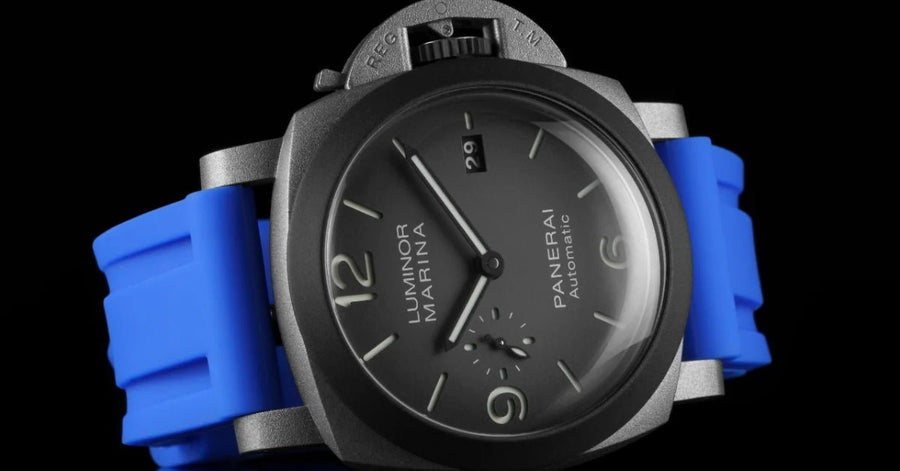
The Luminor 31 Giorni — 44mm in Goldtech, new P.2031/S movement with four mainspring barrels, 3.3 metres of combined mainspring, 31 days of autonomy, patent-pending Torque Limiter — is the power reserve record holder for 2026. Seven years of R&D in Neuchâtel. $107,000. T3 gave it a "Best of Watches & Wonders 2026" award. Robb Report called it "the undisputed star of this year's Luminor releases." The Luminor 8 Giorni "Brunito" in aged-effect burnished steel and the two 47mm naval-heritage references completed a strong Panerai week.
IWC Schaffhausen: Built for Space
The Pilot's Venturer Vertical Drive (Ref. IW328601) is the most surprising single piece of the week. A watch designed from a blank sheet for human spaceflight — no crown, all functions via bezel and rocker switch, certified by private space company Vast, new Calibre 32722 with 120-hour power reserve. Square Mile called it "the most purposeful tool watch at the entire fair." IWC CEO Chris Grainger-Herr: "The first watch ever conceived from the outset to meet the demands of modern space travel." The Ceralume Big Pilot (luminous ceramic that glows intensely blue at night) and the expanded Le Petit Prince collection rounded out a standout IWC week.
Bulgari: Smaller, Thinner, Stronger
The Octo Finissimo 37mm — 65 grams, new BVF 100 in-house movement, three years of development — answered the question the market has been asking for a decade. Available in sandblasted titanium, satin-polished titanium, yellow gold, and a 37mm minute repeater hidden in the same case. The Octo Finissimo Ultra Tourbillon returned in platinum (10 pieces), the world's thinnest flying tourbillon at 1.85mm, now with a blue skeletonised dial. The Serpenti Aeterna in yellow gold, with 225 hours of total development, was the week's most kaleidoscopic jewellery piece.
Grand Seiko: The Most Accurate Diver, Ever
The "Ushio" Diver Spring Drive U.F.A. (40.8mm, High-Intensity Titanium, Calibre 9RB1, ±20 seconds per year, 300m water resistance, $12,400) is the most accurate mainspring-powered dive watch ever produced. The "Ice Forest at Dawn" UFA in 18-carat yellow gold and the "Mystic Waterfall" hand-engraved platinum special — whose case, bezel, lugs, and dial are entirely hand-engraved by traditional artisans — completed a remarkable Grand Seiko presence.
Credor: A Debut That Changes the Conversation
Credor's first Watches & Wonders appearance — three watches, all extraordinary — introduced a brand almost unknown outside Japan to the global stage. The Goldfeather Urushi Lacquer Dial Limited Edition ($47,000, platinum, 25 pieces, taka maki-e with platinum powder) is a piece of traditional Japanese artisanship housed in a 1.98mm-thick movement. The Locomotive Titanium "Dawn Blue" ($13,200, Gérald Genta design, revived from 1994) is the most underrated release of the entire week. If the watch world pays attention, Credor becomes one of the defining names of the next decade.
Notable Further Highlights
Jaeger-LeCoultre presented the Gyrotourbillon À Stratosphère — a triple-axis tourbillon with 98% positional coverage, 189 components weighing 0.78 grams, 22 years in development. Man of Many's reviewer called it "the engineering flex of 2026." The Master Control Chronometre in 38mm and 39mm brought JLC's precision credentials to more wearable proportions.
Chopard marked 30 years of its Fleurier Manufacture with the L.U.C 1860 Anniversary in Lucent Steel with an Areuse Blue dial, and the extraordinary L.U.C Quattro Spirit 25 Straw Marquetry Edition (8 pieces, 192-hour power reserve, hand-crafted straw marquetry honeycomb dial, jumping hour).
Roger Dubuis returned to its founder's 1989 biretrograde patent with the Excalibur Biretrograde Perpetual Calendar and a new in-house Calibre RD580. A brand resetting its credibility through its own history.
Hermès unveiled the H08 Squelette — the first skeleton version of the H08, in 39mm black PVD titanium, all 168 components of the H1978 movement exposed. Lighter and more technically layered than the original.
Zenith introduced the Chronomaster Sport Skeleton — the first skeletonised version of the Chronomaster Sport, El Primero 3600 movement fully exposed, in four references including a 10-piece diamond limited edition.
Hublot marked the Big Bang's 20th anniversary with the Big Bang Reloaded in five materials, architect collaborations with Mbappé and Bolt, and the Spirit of Big Bang Impact with diamonds set directly into sapphire — $543,000, technically unprecedented.
Ressence introduced the Type 11 with its first-ever in-house movement, the Werk RW-01, while maintaining the brand's signature ROCS (Ressence Orbital Convex System). Man of Many's reviewer called it their personal pick if they could walk out with one today.
Piaget presented the Altiplano Ultimate Concept Tourbillon at 2mm thick, now with the revived 1960s "Style Selector" concept allowing clients to choose their own ornamental stone configuration — tiger's eye, jade, sodalite, or onyx, finished with tools as fine as 0.15mm.
H. Moser & Cie delivered the Endeavour Minute Repeater Cylindrical Tourbillon Skeleton, Streamliner in 28mm and 34mm (no compromise on quality in the smaller sizes), and the Streamliner Pump with Reebok — 250 pieces, genuinely fun, fully credible.
Ferdinand Berthoud continued its relentless pursuit of precision with the Chronomètre FB 2TV, housing a flying tourbillon and stop-seconds within a movement of extraordinary finishing standards.
What Watches & Wonders 2026 Actually Told Us
On sizes: The week confirmed conclusively that smaller is not a trend — it is a structural shift. Across every segment and every price point, brands are investing seriously in the engineering of more compact cases. The Octo Finissimo 37, the Saxonia 36mm, the Ushio 40.8mm diver, the Streamliner 28mm and 34mm. These are not compromises. They are purpose-built.
On complications: The most interesting releases of the week were the ones where the complication is the idea, not an addition to justify the price. Parmigiani's disappearing chronograph, the Patek automaton, the IWC no-crown space watch, the AP jumping hour — each of these rethinks the relationship between the wearer and the mechanism.
On anniversaries: The industry handled milestones with more intelligence than usual. Patek's Nautilus 50th returned to a time-only display rather than adding complications. Rolex's Oyster centenary spread across the collection rather than concentrating into a single limited edition. Audemars Piguet's 150th anniversary year was channelled into genuine technical investment rather than commemorative marketing.
On the market: The energy in Geneva this week was that of a market returning to fundamentals. The buyers walking the floor were looking for character and long-term value, not the next hype cycle. Brands that brought both technical substance and design conviction dominated the floor conversation. Brands that offered colourway updates dressed as new releases were largely ignored.
T3 put it best at the close of their week's coverage: "Brands like Audemars Piguet, Parmigiani Fleurier, and Cartier really surprised me with their launches." The implication being that this was a week where the expected performers performed — and the unexpected performances were the ones that defined it.
One More Thing Before Geneva Closes
If this week in Geneva has left you looking at your own watch differently — thinking about what it could be, rather than just what it is — that feeling is exactly what Watches & Wonders is designed to produce.
You may not be able to walk into an authorised dealer and buy any of the watches above today. Most won't be available for months. Some are already allocated. A few never will be. But the watch already on your wrist — your Submariner, your GMT-Master II, your Datejust, your Sea-Dweller — is not waiting for anything. It is ready right now. And the fastest way to give it a new character without a waitlist, an appointment, or a call to your AD is a Helvetus rubber strap, precision-fitted to your specific reference and built to last as long as the movement inside it.
Geneva had a remarkable week. Now the world watches catch up.
Helvetus Watch Straps — precision-engineered rubber straps for Rolex and the world's finest sport watches. Our team covered Watches & Wonders 2026 from Geneva throughout the week. Read all our daily dispatches on the Helvetus blog.