


Changing a watch strap is one of those skills that looks intimidating until you've done it once, and then you wonder why you ever paid a jeweller to do it. The whole process takes about three minutes once you know what you're doing, and the only tool you absolutely need costs less than a sandwich.
The reason it feels intimidating is that you're working with small spring-loaded parts on top of a watch that costs anywhere from a few hundred to several thousand pounds, and one slip can leave a scratch on the lugs that you'll see every time you wear it. So this guide doesn't just walk through the steps. It also covers the small details that separate a clean swap from a damaged watch — which way the strap goes on, how to handle Rolex's thicker spring bars, what to do when the lugs aren't drilled, and how to avoid the two scratches that almost everyone leaves on their first attempt.
What You Need
The list is shorter than you'd think.
A spring bar tool is the only essential. It's a small double-ended tool with a forked tip on one end and a pin on the other. You can buy a basic one for under £5 or a Bergeon-quality one for around £30. The Bergeon 6767 is the industry-standard professional version and is genuinely worth the money if you plan to swap straps regularly. For occasional use, any decent spring bar tool will do the job.
Two tools from our range make this easier: the spring bar tweezer, which grips both ends of the bar at once and keeps the tip away from polished lugs, and the bracelet removal tool, with a forked end for lug widths from 12mm to 26mm.
A soft surface to work on. A microfibre cloth, a leather strap mat, or even a folded tea towel. The watch will rest on this face-down for most of the process, and you don't want anything that'll scratch the crystal.
Good lighting. The lug holes are tiny, and you need to see what you're doing.
A small dish or magnetic tray. Spring bars are about 1.5mm in diameter and they bounce. If one pops loose and rolls off the workbench onto a carpet, you'll be searching for it for an hour. A dish keeps everything contained.
Optional but recommended: a roll of low-tack masking tape. Apply two small pieces over the lugs themselves before you start. If the spring bar tool slips, it slips into the tape instead of into your watch case. This is the single biggest tip experienced collectors give and almost no beginner uses it.
Before You Start: Identify Your Strap Type
There are three main systems, and the swap process is slightly different for each. Look at where your current strap meets the watch.
Standard spring bars are the most common. The strap is held in place by a small spring-loaded metal bar that runs through a tube at the end of the strap. The bar has telescoping tips on each end that compress inward to release. You can't see the spring bar from outside the watch, only the small lug holes (or sometimes nothing at all from the outside, if your lugs aren't drilled).
Quick release spring bars look almost identical but have a tiny lever or knurled tab visible on the underside of the strap, near each lug. You slide the lever sideways with your fingernail and the spring bar retracts on its own — no tool required. Most modern straps from premium brands, including all Helvetus rubber straps, come with quick release as standard. If your current strap has them, count yourself lucky.
Integrated bracelets (Patek Nautilus, AP Royal Oak, certain Cartier Santos configurations) don't use a standard strap end at all. The strap or bracelet end is shaped to fit the case profile, and you can't just swap in any 20mm strap. You need a strap engineered specifically for that watch reference.
If you don't know which system you have, flip the watch over and look at the underside where the strap meets the lugs. A small lever or tab visible from the back means quick release. Just two clean lug holes and no visible mechanism means standard spring bars.
Method 1: Quick Release Straps (the easy one)
If both your old strap and your new strap have quick release, this takes under a minute.
Lay the watch face-down on your soft surface. Hold the watch firmly in your non-dominant hand. With your dominant hand, find the small knurled tab or lever on the underside of the strap, right next to one of the lugs. Slide it sideways toward the centre of the strap. You'll feel the spring bar retract. The strap end will lift away from the lug.
Repeat on the other lug. The strap is now off.
To install the new strap, do the reverse. Slide the quick release tab to retract one end of the spring bar, position the strap end inside the lugs, and let go. The spring bar will snap back into the lug hole. Do the same on the other side. Give the strap a gentle tug to confirm both sides are seated.
That's it. The whole process takes thirty seconds with practice.
Method 2: Standard Spring Bars (the slightly trickier one)
Most aftermarket straps and most factory leather and rubber straps still use standard spring bars. The process is straightforward but requires a tool and a bit of care.
Step 1. Apply masking tape to the outside of the lugs if you're using it. Two small strips, one on each side.
Step 2. Lay the watch face-down on your soft surface. Identify which way the spring bar tool needs to come in. You'll be using the forked end, and the goal is to slip the fork between the strap and the inside of the lug, catching the small lip of the spring bar's telescoping tip.
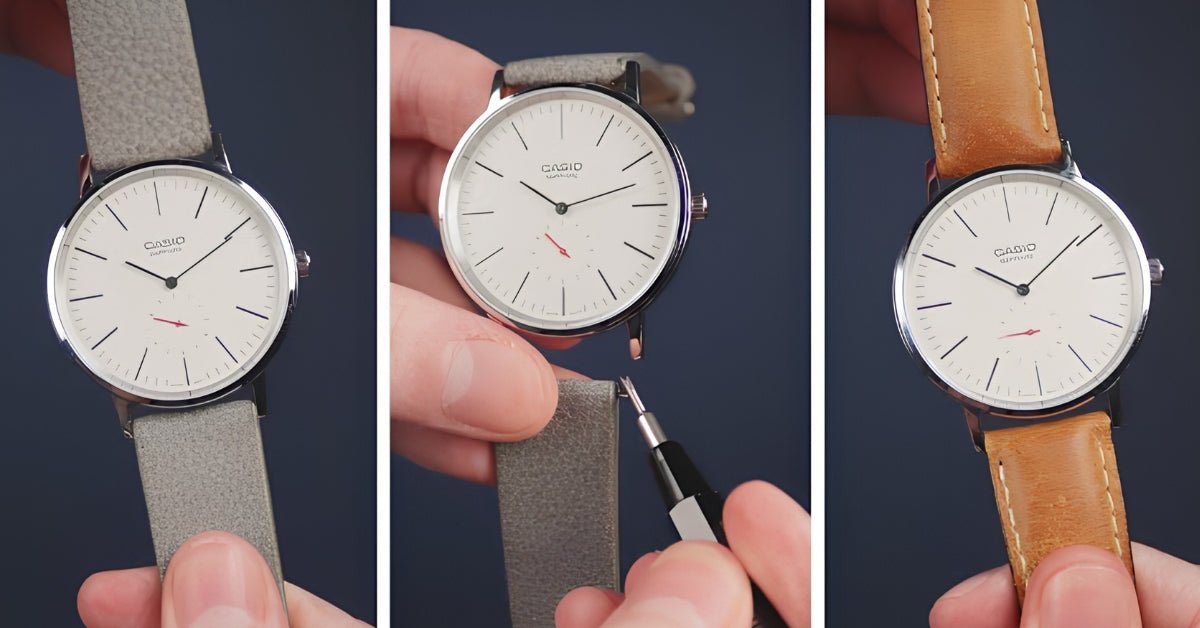
Step 3. Slide the forked end of the tool into the gap between the strap and the lug, on either side. You're looking for the small lip of the spring bar. When the fork catches it, you'll feel a slight resistance.
Step 4. Pull the fork toward the centre of the strap. This compresses the spring bar inward. The end will release from the lug hole. Once one side is free, the strap will pivot loose. Don't let go of the spring bar yet — slide the strap out, and the spring bar will come with it.
Step 5. Repeat for the other lug. The strap is now off.
Step 6. To fit the new strap, push the spring bar through the tube at one end of the new strap, leaving equal length protruding on each side. Position the strap inside the lugs. Push one end of the spring bar into one lug hole until it seats. Use the spring bar tool to compress the other end inward until you can guide it into the opposite lug hole, then let it spring outward into place. You should hear or feel a faint click.
Step 7. Repeat for the second strap end. Tug both ends of the strap firmly to confirm the spring bars are properly seated. If a strap pulls free under light pressure, the spring bar didn't fully engage — re-do that side.
Method 3: Drilled Lugs (the easiest of the standard methods)
Some watches — older Rolex sports models, certain Tudor pieces, and a handful of specialist tool watches — have small holes drilled all the way through the outside of the lugs. You can see them from the side of the case.
If your watch has drilled lugs, the process is much easier. Use the pin (pointed) end of the spring bar tool, push it into the small hole from the outside of the lug, and press inward. The spring bar will compress and release on that side. Lift the strap free and repeat on the other side.
Drilled lugs almost eliminate the risk of scratching the case, which is why a lot of collectors specifically seek out drilled-lug versions of their favourite watches.
Which Way Does the Strap Go On?
This trips up almost everyone the first time. The buckle end of a two-piece strap goes on the 12 o'clock side (the top). The longer end with the holes goes on the 6 o'clock side (the bottom). When you look at your wrist, the buckle should sit above the watch face, not below it.
The reason: when you fasten the strap, the holes-and-tongue side wraps around the underside of your wrist, and the buckle naturally rests on the side. If you put the buckle on the bottom, the strap will feel reversed and the buckle won't sit where it's meant to.
If you accidentally install it the wrong way round, you'll know within thirty seconds of putting the watch on. Just swap the two strap ends.
Special Case: Rolex Spring Bars
Rolex uses thicker, beefier spring bars than most other manufacturers. They're designed for security — you don't want a Submariner falling off your wrist mid-dive — but they're noticeably harder to compress with a standard spring bar tool, and the extra thickness means there's less clearance between the spring bar and the case.
Two practical implications. First, you'll need to apply more pressure than you would with an Omega or Tudor. Don't be afraid to push firmly. Second, fitting a single-pass strap (NATO-style) on a Rolex sports model often requires removing the spring bars entirely, because there's not enough space between the bar and the case to thread a strap through. For a standard two-piece swap, the OEM spring bars work fine and you should keep them. Just budget a bit more time and care for Rolex strap changes than you would for other brands.
If you're upgrading a Rolex with a rubber strap, our collection of straps for Rolex includes options that ship with appropriately-sized spring bars and quick release pins specifically engineered to work with Rolex case tolerances.
How to Avoid the Two Most Common Scratches
There are two scratches that almost every beginner leaves on their first strap change, and both are entirely preventable.
The lug-tip slip scratch. This happens when the spring bar tool slips off the spring bar and skids across the outside of the lug. The mark looks like a thin curved line on the polished or brushed surface of the lug. Prevention: apply masking tape to the lugs before you start, and approach the spring bar from the inside of the strap, not from the outside.
The case-back scratch. This happens when the watch slides on the workbench mid-pry, and the case-back drags across whatever's underneath. Prevention: work on a soft surface (microfibre, leather, towel — never a bare desk) and grip the watch firmly throughout. Don't try to apply spring bar pressure with the watch loose on the bench.
Take your time on the first few swaps. Speed comes naturally after about ten changes.
When to Take It to a Jeweller Instead
Most watches and most straps are fine to change at home. There are a few situations where you might want professional help.
If your watch has an integrated bracelet system that you've never worked with, get the first swap done by a watchmaker who can show you the technique.
If the spring bars are seized or corroded — common on vintage watches — they can require specialist removal that's safer in trained hands.
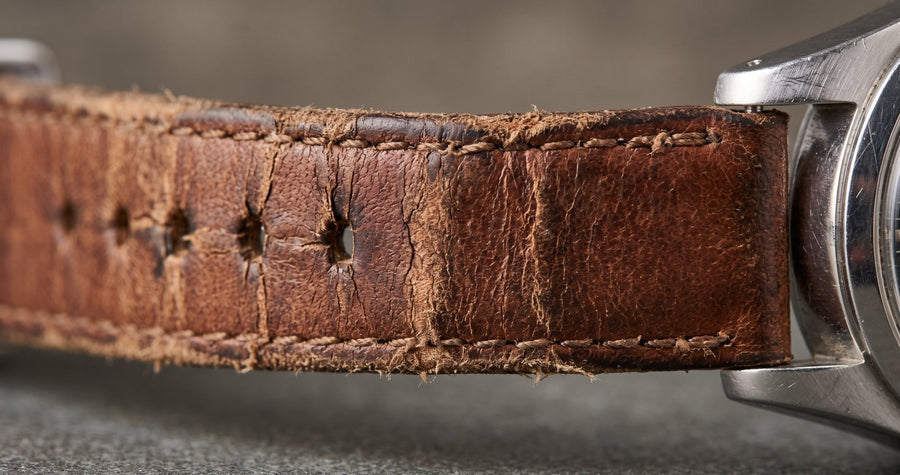
If the watch has historic, vintage, or sentimental value where you genuinely cannot risk a scratch, it's worth £10 or so to have a jeweller do it while you watch.
For everything else — modern Rolex, Tudor, Omega, Cartier, Panerai, IWC, and almost any rubber or leather strap swap — you'll save time and money by doing it yourself.
Frequently Asked Questions
Do I need a special tool to change a watch strap? Yes — a spring bar tool. It's a small double-ended tool that costs anywhere from £5 to £30. Without it you can't safely compress the spring bars, and trying to use a paperclip or kitchen knife is how watches get scratched.
Can I change a Rolex strap at home? Absolutely. The only difference is that Rolex spring bars are thicker and require slightly more pressure to compress. Use a quality spring bar tool, tape the lugs, and take your time. Tens of thousands of Rolex owners change their own straps without issue.
Will changing the strap void my watch's warranty? No. Replacing the strap on a luxury watch doesn't affect the warranty on the watch itself, because the strap and the watch are separate components. The original bracelet or strap can be reinstalled at any time. We covered this in more detail in our Rubber vs. Leather Watch Straps guide.
How often should I change my watch strap? There's no rule. Leather straps typically last 1–3 years with regular wear before they need replacing. Rubber and FKM straps last much longer — premium FKM straps can last a decade or more with reasonable care. Many collectors rotate between several straps to extend the life of each.
What if I lose a spring bar? They're cheap and standardised. A pack of replacement spring bars in the right size costs a few pounds, and any 20mm or 22mm spring bar will fit any watch with a matching lug width — though for Rolex specifically you'll want to use OEM-thickness bars. Keep a spare set in your watch drawer.
Why did my new strap fall off after I installed it? The spring bar didn't fully seat in the lug hole. When this happens, the strap feels secure at first but releases under pressure. Always tug both ends of the strap after fitting to confirm the bars are locked. If anything moves, redo it.
For broader background on the components involved, DW's article on the spring bar covers the engineering history.
The Bottom Line
Changing a watch strap takes about three minutes once you've got the hang of it. Buy a spring bar tool, work on a soft surface, tape the lugs if you're cautious, and approach the spring bars from inside the strap rather than from outside. Quick release straps are the fastest. Drilled lugs are the easiest. Standard spring bars take a bit of practice but become second nature within a few attempts.
Once you can swap straps confidently, your single watch effectively becomes five watches. A Submariner on a black rubber is a tool watch. The same Submariner on a tan leather is a weekend piece. On a sailcloth it splits the difference. The transformation is what makes strap-changing one of the most satisfying skills in the hobby.
If you're ready to upgrade, our full range of premium rubber, leather, sailcloth, alligator, suede, and ostrich straps for Rolex, Cartier, Omega, Tudor, Panerai, and other major brands is available at helvetus.com, and our Strap Finder will match your watch to the correct width and end-fit in seconds. You can also browse our tools and accessories collection if you still need a spring bar tool.