


Very few watches are re-strapped as often as a Panerai Luminor. The case is broad and flat, the strap sits proud of the wrist, and a single reference genuinely looks like a different watch on black rubber than it does on brown leather. Owners know this, which is why most people who buy a Luminor end up owning several straps for it.
The problem is that "Panerai Luminor" is not one size. The family runs from a 38mm Due to a 47mm 1950 case, and the strap width changes four times across that range. Order on the model name alone and there is a real chance the strap will not go in. This guide gives you the width for your case size, shows you how to check the way your particular Luminor attaches its strap, and then recommends the straps that actually suit the watch.
Panerai Luminor lug width by case size
Panerai does not print lug widths on the watch, and the reference number does not tell you either. Go by case diameter — it is the reliable route for this family.
| Your Luminor | Strap width to select | Typical factory taper |
|---|---|---|
| Luminor Due 38mm | 20mm | 20/18mm |
| Luminor 40mm | 22mm | 22/20mm |
| Luminor 42mm / Luminor Due 42mm | 22mm | 22/20mm |
| Luminor, Luminor Marina, Luminor 1950 44mm | 24mm | 24/22mm |
| Luminor 47mm | 26mm | 26/22 – 26/26mm |
Three things worth knowing before you order:
- 24mm covers the biggest share of the family. The 44mm case is the classic Luminor size, so if you own a Luminor Marina and you have never checked, 24mm is almost certainly your number.
- The 40mm case is the one exception worth a quick check. Most 40mm Luminors take 22mm, but a small number of 40mm cases measure 20mm. Lay a ruler across the gap between the lugs before you buy.
- 45mm cases are genuinely disputed. Strap specialists split between 24mm and 26mm on 45mm references. Measure yours, or message us with your reference and we will confirm it before you order.
To measure it yourself: lay a ruler across the inside gap between the lugs, at the point where the bar sits. That gap, in millimetres, is the number you select on the product page.
Check how your strap attaches before you order
This is the step most Luminor owners skip, and it is the one that decides whether the swap takes two minutes or ruins an afternoon.
Most classic Luminor and Luminor Marina references do not use spring bars. They use a screw bar — a bar that passes through a tube in the lug and threads into a screw on each side. A spring bar tool is the wrong instrument entirely. What you need is a small flat screwdriver, and three habits: work over a tray so a screw that drops does not vanish into the carpet, never force a screw that has started to bind in the tube, and keep the original screws somewhere safe as spares.
Some references use standard spring bars instead, including parts of the Luminor Due range, and some current models use Panerai's own quick-release fitting. You can tell which you have by looking at the outside of the lug: a small slotted screw head means screw bars, a plain lug face usually means spring bars.
If you are not sure, send us a photo of the watch from the side with the lugs visible and we will tell you which system you are looking at before you spend anything.
Why the strap matters more on a Luminor than on almost any other watch
The Luminor grew out of instruments made for the divers of the Italian Navy, and the design still shows it: a cushion case, a sandwich dial with the luminous material sitting behind the numerals rather than printed on top, and the crown-protecting bridge that has defined the model since the 1950s. It was equipment first and jewellery never.
That heritage is exactly why collectors treat the strap as part of the watch rather than an accessory. A Luminor was originally issued on a simple strap; there is no "correct" bracelet look to depart from. It is also a large, thick watch — a 44mm Marina is around 15.5mm tall — and how the first centimetre of the strap behaves decides whether the case settles onto the wrist or bridges across it. A strap that bends at the lug makes a 44mm Luminor wear smaller. One that stays rigid makes it wear bigger than it is.
Two practical consequences. First, the end shape matters as much as the width on a cushion case — the case curves away where the strap meets it, so a curved end continues the line where a flat cut leaves a visible gap. Second, thickness should answer the case. A slim dress strap looks lost between wide Luminor lugs; on a slim Luminor Due the opposite is true, and a thick strap hands back the height the Due was designed to save.
The best straps for the Panerai Luminor
1. Black curved rubber — the default for a 44mm Luminor
If you own a 44mm Luminor or Luminor Marina, start with the black curved rubber strap for the Panerai Luminor 44mm. It is cut specifically for the 44mm case, so the curved end meets the case instead of leaving the wedge-shaped gap a straight-cut strap leaves on a cushion case. Black is the configuration the watch is photographed in more than any other, it suits every dial colour Panerai makes, and it is the one strap that is never the wrong choice. Rubber straps carry our lifetime warranty.
This is consistently one of the most popular choices among Luminor owners, and for most people it is the strap that stays on the watch between experiments.
2. Black rubber, straight cut — the answer for every other size
For a Due 38, a 40, a 42 or a 47, the black rubber strap for Panerai is the equivalent pick. It is offered in 20, 22, 24 and 26mm, so whatever your case size, the width is on the shelf — select yours on the product page. At 3mm it is thin enough not to undo the proportions of a slim Luminor Due, and it carries the same lifetime warranty.
3. Brown leather — the pairing the Luminor is historically known for
Leather is where a Luminor looks most like itself. The brown leather strap for Panerai is the warm option: brown against a black sandwich dial and a brushed steel case is the combination most people picture when they picture the model, and it is the obvious choice on any Luminor with a tobacco, brown or warm-toned dial, or a gold-tone case. Available in 22, 24 and 26mm.
If you would rather keep it strictly formal, the black leather strap for Panerai covers 20, 22, 24 and 26mm and is the cleaner, quieter version of the same idea. Leather straps carry a one-year warranty rather than the lifetime cover on rubber.
4. Blue rubber — for the blue-dial references
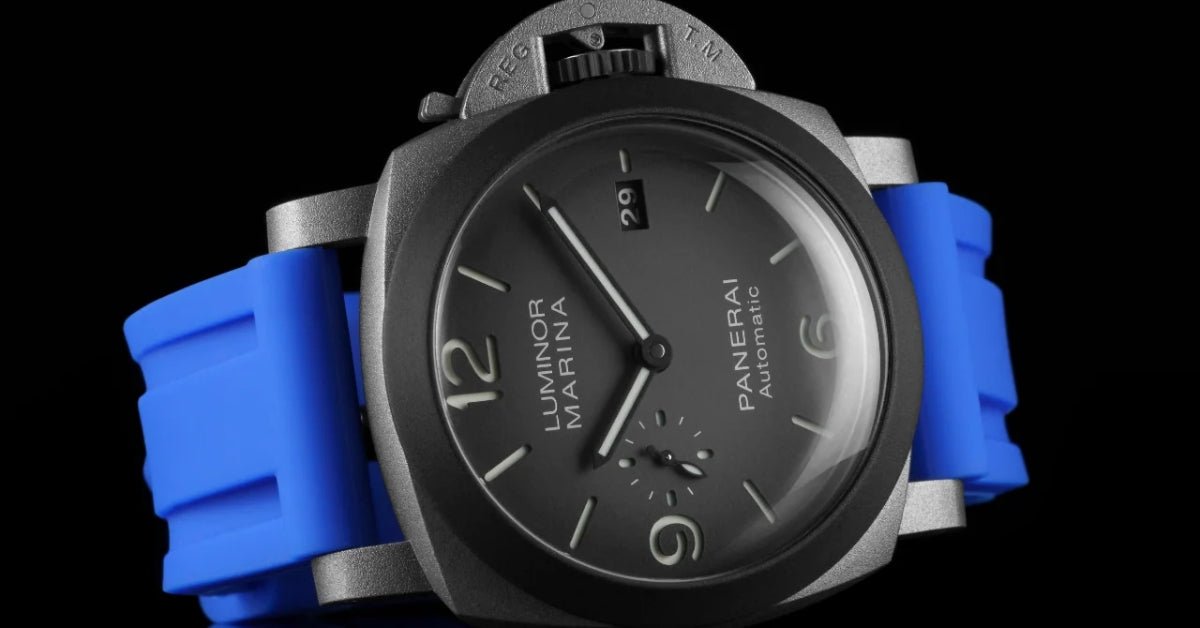
Blue is the second most common Luminor dial after black, and the blue rubber strap for Panerai is the tonal answer for it: the strap repeats a colour already on the watch rather than introducing a new one, which is why it reads as considered rather than loud. Offered in 20, 22, 24 and 26mm, with the lifetime warranty.
Matching the strap to your dial
The Luminor has no coloured bezel insert, so unlike a Submersible the colour decision is made by the dial and the case finish. The safe rule is to repeat something already on the watch:
- Black dial → black rubber, or brown leather if you want warmth. The two straps that cover almost every Luminor made.
- Blue dial → blue rubber, tonal. Or black, which never fights a blue dial.
- Grey or anthracite sandwich dial → grey rubber picks up the dial and the brushed case at once.
- Gold-tone, bronze or warm-cased references → brown leather. Steel-toned straps look cold against a warm case.
- Something with more character → the black rubber curved strap with a white LuxLine® or the red LuxLine® version keep a black body and add a single raised line, which is a far safer way to add interest than a solid bright colour. Both in 22 and 24mm.
If you want the full range — including military camouflage, white, light blue, orange, curved green, military green and navy — browse the full Panerai strap collection.
The buckle and the tool
Every strap ships with the buckle you select, so you are covered whether or not you keep your original hardware.
If you plan to reuse your Panerai buckle, check the width at the buckle end, not the case end. Panerai straps taper, so a 24mm strap finishes at 22mm and a 22mm strap finishes at 20mm — the buckle is sized to the narrow end. Match that number and it carries over.
And because most Luminors use screw bars rather than spring bars, the Panerai strap installation tool is worth adding to the first order. It is the correct instrument for the job, and it is the difference between a clean swap and a scratched lug.
Frequently asked questions
What size strap does a Panerai Luminor take? It depends on the case. A 44mm Luminor or Luminor Marina takes 24mm. The 40mm and 42mm cases take 22mm, the 38mm Luminor Due takes 20mm, and 47mm cases take 26mm.
What lug width is the Panerai Luminor Marina 44mm? 24mm at the case, tapering to 22mm at the buckle.
Can I put a rubber strap on a Panerai Luminor? Yes, and it is the most common upgrade owners make. Rubber suits the Luminor's tool-watch character, handles water and sweat far better than leather, and on a heavy case it is more comfortable for long wear.
Do I need a special tool to change a Panerai strap? Usually yes. Most classic Luminor references use screw bars rather than spring bars, which need a small flat screwdriver rather than a standard spring bar tool.
Will a generic 24mm strap fit my Luminor? It will physically fit if the width is right, but on a cushion case a straight-cut end leaves a visible gap where the case curves away. A strap cut for the Luminor sits flush.
Ready to re-strap your Luminor?
Helvetus straps are made for one job: fitting specific watches properly. Every Panerai strap is cut for the case rather than sold as a universal band, our rubber straps are covered by a lifetime warranty, shipping is free worldwide with no import costs, and more than 50,000 customers have re-strapped their watches with us.
Pick your width, pick your colour, and see what your Luminor looks like as a different watch.
Shop all Panerai watch straps →
Helvetus is not affiliated with or sponsored by Panerai. Model names are used for compatibility reference only.